

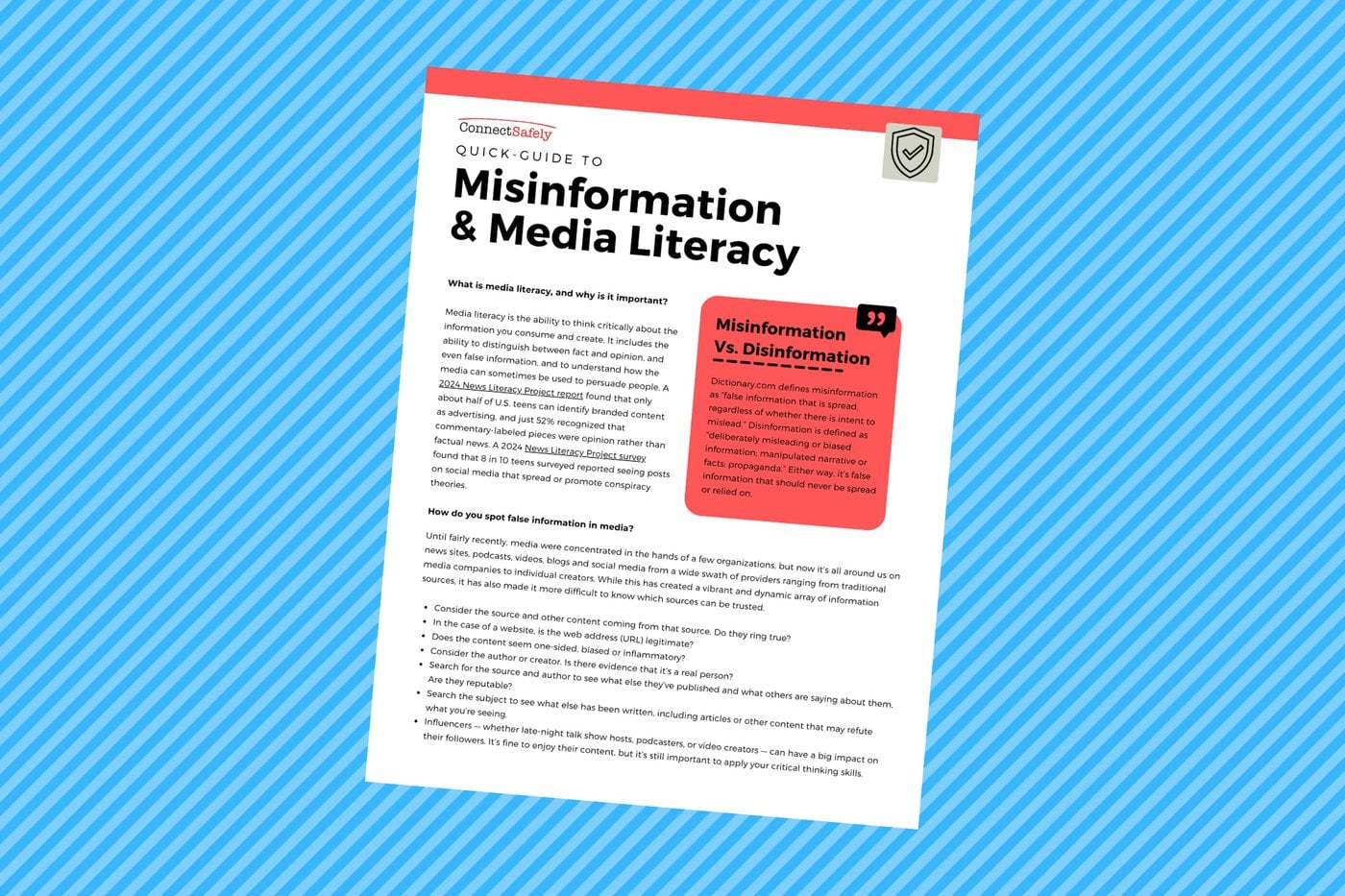
What is media literacy, and why is it important?
Media literacy is the ability to think critically about the information you consume and create. It includes the ability to distinguish between fact and opinion, and even false information, and to understand how the media can sometimes be used to persuade people. A 2024 News Literacy Project report found that only about half of U.S. teens can identify branded content as advertising, and just 52% recognized that commentary-labeled pieces were opinion rather than factual news. A 2024 News Literacy Project survey found that 8 in 10 teens surveyed reported seeing posts on social media that spread or promote conspiracy theories.
How do you spot false information in media?
Until fairly recently, media were concentrated in the hands of a few organizations, but now it’s all around us on news sites, podcasts, videos, blogs and social media from a wide swath of providers ranging from traditional media companies to individual creators. While this has created a vibrant and dynamic array of information sources, it has also made it more difficult to know which sources can be trusted.
- Consider the source and other content coming from that source. Do they ring true?
- In the case of a website, is the web address (URL) legitimate?
- Does the content seem one-sided, biased or inflammatory?
- Consider the author or creator. Is there evidence that it’s a real person?
- Search for the source and author to see what else they’ve published and what others are saying about them. Are they reputable?
- Search the subject to see what else has been written, including articles or other content that may refute what you’re seeing.
- Influencers — whether late-night talk show hosts, podcasters, or video creators — can have a big impact on their followers. It’s fine to enjoy their content, but it’s still important to apply your critical thinking skills.
How do you verify information from Generative AI (GAI)?
Generative AI tools are still new and evolving. They don’t actually “know” the truth — they generate responses based on patterns in their training data, which means their answers can sound confident but be wrong, outdated, or biased. GAI can be useful for brainstorming and getting started, but it is not automatically reliable. You — not the AI — are responsible for making sure the information is real.
- Cross-check with trusted sources. Look for the same information on credible news outlets, academic journals, or official (government, school, medical) websites.
- Ask for sources. If the AI doesn’t show where it got the information, ask it to cite sources — and then check those sources yourself.
- Ask it to check itself. You can ask a GAI service to fact-check its own answer, and you may get a different response. Treat that second answer as a lead, not proof, and verify that too.
- Do an independent search. Don’t rely only on what the AI tells you. Look it up on your own to confirm.
- Even if you feed it information or ask it to help rewrite something you’ve written, check to make sure it got it right. It doesn’t always
- Pause before sharing. Never cite, post, forward, or act on AI-generated information until you’re confident it’s accurate.
What should you do if you see something on social media that seems fishy?
- Pause before sharing. Take a moment to question it — if it seems too outrageous or emotional, that’s a red flag.
- Search for it. Paste a key phrase into a search engine to see if reliable outlets confirm or dispute the claim.
- Check fact-checking sites like FactCheck.org, Snopes.com, or PolitiFact.com.
- If it’s false, consider speaking up politely. You can share a correction or a link to credible information.
More about misinformation and media literacy
Facts, opinions and analysis in the news. It’s helpful to understand the difference between facts, opinions, and analysis. Facts are verified pieces of information. Opinions reflect what someone thinks or feels. Analysis helps explain why the facts matter and what they might mean for people and society.
TIP: Teachers and parents can ask students to take a news story or a historical event and write two editorials from opposing perspectives. The idea is to push them to see the same set of facts from at least two different perspectives.
Dealing with conflicting reports. Often, as new information comes to light or even when we review hotly contested historical events, there might be conflicting reports by different sources.
TIP: When faced with the reporting of conflicting facts, encourage students to take their time to develop their own understandings. Analyzing and interpreting information is not a race. Ask them:
- How many other sources are reporting the same facts? Find corroboration.
- Do the corroborating sources seem to be reporting other believable facts?
- Do any of the sources or facts seem biased or skewed to favor one side?
The ability to make informed decisions shapes our democracy. As parents and educators, it’s our job to help young people hone their critical thinking skills so they can analyze information effectively and come to their own conclusions. It’s essential for all aspects of their lives and all decisions they will face, ranging from what to buy, what media to create and how, who to form relationships with and, of course, how to vote. We should not tell them what to think, but rather should teach them how to think for themselves, based on accurate information.